
Peptide therapy marketing for clinics and med spas is an opportunity to position your practice as a trusted authority in personalized wellness, recovery, and healthy aging. The growth in the popularity of peptides has not only generated interest from the general public but has also created a growth opportunity for clinics and med spas. Now more than ever, patients are searching for ways in which peptides can help with their weight management, skin health, sexual wellness, recovery, and healthy aging. Even with all this interest, appointments for your med spa or clinic will not magically happen. A practice must explain what it offers, who supervises treatment, how patients are evaluated, and why its approach to peptides deserves trust.
Effective peptide therapy marketing for clinics and med spas balances education with promotion. It helps patients understand that peptides are not interchangeable products and that treatment begins with a clear goal and understanding of the desired results. It also gives the clinic or spa room to explain its standards, provider experience, and follow-up process before price becomes the patient’s main consideration. This builds a stronger foundation than discounts, dramatic claims, or campaigns centered on whichever peptide is trending online.
Should Your Clinic or Med Spa Offer Peptide Therapy?
Peptide-based treatments keep growing in popularity as patient awareness, clinical adoption, and demand continue to rise. In November 2025, KFF reported that 12% of U.S. adults were currently taking a GLP-1 medication and 18% had used one at some point. Among adults diagnosed as overweight or obese who were not currently using a GLP-1, 43% said they were interested in trying one. GLP-1 medications represent only one part of peptide-based medicine, but their adoption has made patients far more familiar with injectable treatments, medical weight management, and ongoing provider supervision.
Clinical use also demonstrates that this interest goes beyond social media trends. CDC data estimates that 6.9 million American adults with diagnosed diabetes used GLP-1 injectables in 2024, representing 26.5% of that patient population. Separately, one market forecast estimates that the global peptide therapeutics market will grow from approximately $53.9 billion in 2026 to $85.4 billion by 2033. Market estimates vary depending on which drugs and applications are included, but the overall direction points to continued investment, research, and patient awareness.
For clinics and med spas, the advantage is not limited to adding another treatment to the menu. A well-structured peptide program can generate new consultations, create referrals between existing services, and give patients a reason to remain within one practice for related care. Evaluations, laboratory testing, treatment adjustments, and follow-up visits can produce a longer patient relationship than a one-time aesthetic procedure. The service may also help a practice differentiate itself from nearby competitors and retain patients who might otherwise turn to a national telehealth company or an online peptide seller.
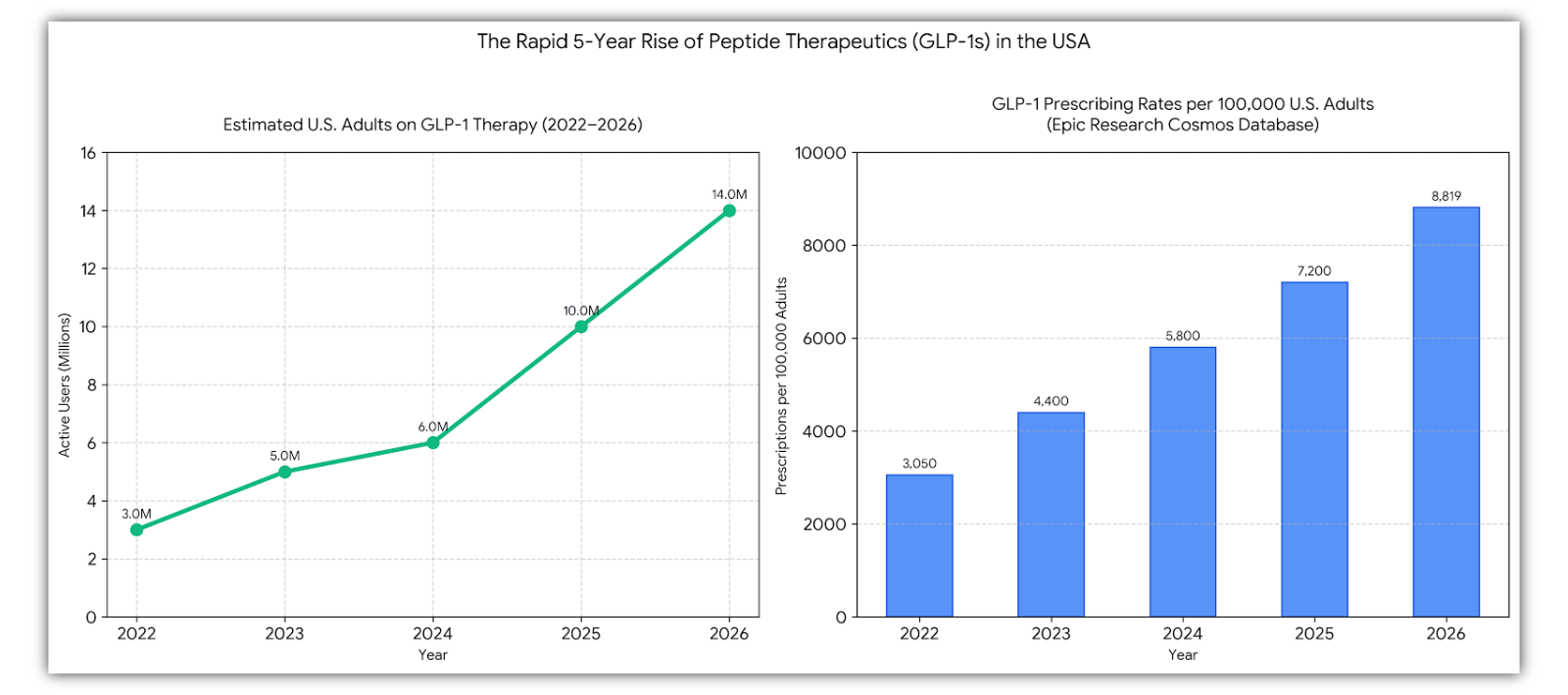
Demand, however, should not determine the treatment menu by itself. The practice or med spa still needs qualified medical oversight, reliable sourcing, appropriate prescribing procedures, staff training, and a clear understanding of the evidence supporting each therapy. The most successful programs select peptide services that make sense for the practice’s specialty and existing patient base. A dermatologist may focus on skin, hair, and healthy-aging concerns, while a bariatric clinic may build a more comprehensive metabolic and weight-management program. The opportunity is strongest when growing public interest is matched with a credible clinical position and a reliable plan for ongoing care.
Marketing Peptides for Clinics
Medical Clinics already have an important advantage when it comes to peptide therapy marketing, because patients already associate them with medical evaluation and professional oversight. Marketing should reinforce that trust rather than imitate supplement companies or online sellers. Website design, local SEO, PPC, email, educational content, and video marketing can introduce peptide therapy within the clinic’s existing specialty. Clinics or doctors best positioned to capitalize on this opportunity include:
Dermatologists
For dermatologists looking to provide peptide therapy, their dermatology practices can discuss peptide therapy in relation to skin quality, hair concerns, wellness, and healthy aging when clinically appropriate. Marketing should distinguish medical treatment from topical peptide products sold by cosmetic brands. A dedicated service page for dermatology peptide marketing can explain consultations, provider involvement, and realistic expectations, while local SEO helps nearby patients find supervised care.
Gynecologists (OB/GYNs)
Gynecologists or OBGYN practices are well-positioned to offer peptide therapy because they already treat concerns related to hormonal changes, menopause, energy, body composition, sexual wellness, and overall quality of life. Their existing patient relationships and women’s health expertise make it easier to introduce peptide therapy as part of a broader, medically supervised treatment plan. Clear website content, discreet communication, and strong reputation management can also help patients feel more comfortable asking sensitive questions.
Cosmetic Surgeons
Cosmetic surgeons may introduce peptide therapy within a larger aesthetic or wellness program. Where appropriate, it can be discussed alongside treatment planning, recovery support, or body-composition goals. Marketing should not imply guaranteed healing or better surgical outcomes. Surgeon-led videos and a focused landing page can explain the practice’s approach without distracting from its core procedures.
Urologists
Urology patients often research private concerns before contacting a physician. Peptide marketing should therefore be discreet, informative, and easy to navigate. It may support conversations around sexual wellness, hormones, or body composition. Carefully written paid search campaigns, confidential inquiry options, clear credentials, and respectful follow-up can help the practice earn trust.
Bariatricians
Bariatricians and medical weight-management clinics are positioned to discuss peptide-based medications because patients already expect screening, monitoring, nutrition guidance, and ongoing support. The campaign should promote the complete medical program, not merely an injection. SEO, PPC, and content marketing can address candidacy, plateaus, follow-up, and maintenance while analytics identify which messages attract qualified patients.
Endocrinologists
Endocrinologists can bring medical context to a subject often oversimplified online. Patients may arrive with information from social media or wellness forums, but little understanding of indications, limitations, product differences, or risks. Articles, FAQs, interviews, and physician videos can demonstrate expertise while supporting visibility in traditional search and AI-generated answers.
RELATED: Funnel For Med Spa Growth
Marketing Peptides For Med Spas
Med spas can benefit from growing interest in wellness and age-management services, but they compete in a market crowded with aggressive claims and similar offers. Successful marketing should show who performs the evaluation, who supervises treatment, and what follow-up includes. Website design, social media, PR, video, professional photography, and print materials can make the service feel established rather than hastily added.
Aesthetic and Skin Med Spas
Aesthetic med spas can introduce peptides within treatment plans that may include injectables, lasers, skin rejuvenation, or hair restoration. The value lies in explaining how services may work together toward a patient’s goals. Educational social posts, short videos, and polished service pages can build interest without relying on sensational promises. Recommendations should always appear individualized.
Anti-Aging Med Spas
Anti-aging med spas already attract patients interested in energy, sleep, recovery, body composition, and longevity. This makes peptide therapy a natural educational topic, but it also creates temptation to overstate results. A better campaign explains the assessment, treatment process, and need for follow-up. SEO, PPC, social media, and email nurturing can keep the practice visible while prospects decide.
RELATED: How To Get More Patients in Los Angeles
Peptide Thought Leadership
Peptide therapy is surrounded by fast-moving claims, conflicting information, and incomplete explanations. This creates a valuable public relations opportunity for clinics and med spas with qualified providers who can communicate responsibly. By publishing provider-reviewed articles, research summaries, educational videos, webinars, and expert commentary, a practice can become a trusted source for patients, journalists, and other healthcare professionals.
A strong PR strategy can position providers for interviews with local television and radio stations, health and wellness publications, women’s health outlets, medical trade media, podcasts, and digital news platforms. Rather than directly promoting treatments, providers can discuss broader topics such as healthy aging, menopause, recovery, metabolic health, treatment safety, and how patients should evaluate peptide-related claims. Timely, balanced commentary makes a provider more useful to journalists and increases the likelihood of recurring media opportunities.
Credibility is especially important in healthcare. A 2025 KFF poll found that 84% of U.S. adults trust their own doctor to make the right health recommendations. Research from Edelman and LinkedIn also found that 73% of surveyed business decision-makers considered thought leadership more trustworthy than traditional marketing materials, while 54% said consistently strong thought leadership prompted them to research an organization’s services or capabilities. Although these figures come from a business audience, they illustrate how credible expert content can influence trust and purchasing decisions.
Effective thought leadership should not sound like advertising. It should acknowledge uncertainty, distinguish between different therapies, explain possible risks and limitations, and clearly state when evidence is still developing. Earned media coverage can then be featured on the clinic’s website, provider biographies, social media, email campaigns, and consultation materials. This third-party visibility strengthens reputation, supports search and AI visibility, and can help turn provider expertise into more qualified patient inquiries.
Peptide Patient Education
Patient education about peptides should begin before the consultation, and a provider-reviewed blog should serve as its foundation. Many prospective patients do not understand the differences between peptides, hormones, FDA-approved medications, compounded preparations, and products labeled for research use. Blog articles can address these distinctions, correct common misconceptions, explain what the evaluation process involves, and help patients develop more realistic expectations.
A consistent blog also supports visibility and lead generation. HubSpot’s 2025 blogging research found that 66% of businesses use blogs to build brand awareness, 53% use them to improve customer engagement, and 49% use them to generate leads. Orbit Media’s 2025 survey found that approximately 81% of content marketers reported receiving at least some measurable results from blogging, including 21% who reported strong results.
Articles can answer questions such as who may qualify for treatment, what patients should ask during a consultation, how different therapies compare, and why medical supervision matters. Each article can then be repurposed into videos, email sequences, social media posts, downloadable guides, and in-office materials.
Educational blog content can also improve lead quality by discouraging price-only inquiries and preparing prospective patients before they contact the practice. Regular website maintenance keeps older articles accurate, while analytics can identify which blog topics attract qualified visitors, generate consultation requests, and contribute to patient conversions. A well-organized library of provider-reviewed content also gives search engines and AI platforms clearer, more authoritative material to reference.
Peptide Therapy FDA and Marketing Regulations
Peptide therapy marketing for clinics and med spas must account for FDA and FTC requirements, state medical advertising rules, patient privacy, and each advertising platform’s policies. A claim can come from an ad, headline, testimonial, image, or the overall impression of a landing page. The FTC requires health-related claims to be truthful, not misleading, and supported by appropriate evidence. See the FTC’s official Health Products Compliance Guidance.
Google Ads, formerly called AdWords, has separate healthcare and medicines rules. Google may review the ad, keywords, landing page, website content, targeting, account history, and other business information. Clinics should read Google’s Healthcare and medicines policy before launching a peptide campaign.
Google restricts prescription drug terms in ads, landing pages, and keywords. Whether a term is allowed depends on the location, advertiser, and campaign purpose, and some advertisers require certification. The details appear in Google’s Restricted drug terms policy.
Google also prohibits advertising certain unapproved substances. Its examples are not exhaustive, so a peptide’s absence from the published list does not automatically make it acceptable. Review the Unapproved substances policy and the unapproved pharmaceuticals and supplements list.
Targeting can create another violation. Health is a sensitive interest, which limits advertiser-created audiences. Remarketing, Customer Match, and similar methods may not be available in the same way they are for ordinary consumer services. Google explains these limits in its Personalized advertising targeting policy.
A policy mistake does not always cause an immediate ban. Google may first disapprove an ad or temporarily hold an account. Repeated violations can lead to strikes and suspension, while an egregious violation can result in immediate suspension without warning. Review Google’s policy enforcement guidance and account suspension overview.
Trying to hide restricted content, change landing pages to evade review, or open new accounts to bypass enforcement may be treated as circumventing systems. Google classifies this as an egregious violation that can trigger suspension upon detection. See the official Circumventing systems policy.
Practices must also describe compounded drugs accurately. Compounded drugs are not FDA-approved, and the FDA does not verify their safety, effectiveness, or quality before marketing. The agency has warned businesses about false or misleading promotion. Review the FDA’s Compounding questions and answers and compounded drug promotion guidance.
Patient privacy applies to testimonials, photographs, email campaigns, and advertising data. In many situations, HIPAA requires written authorization before protected health information is used or disclosed for marketing. HHS explains this in its official HIPAA marketing guidance.
X Design Solutions can coordinate peptide therapy marketing for clinics and med spas across website design, SEO, PPC and SEM, content marketing, social media, video, email, public relations, reputation management, print, analytics, AI search visibility, and ongoing website maintenance. The goal is to attract qualified patients while protecting the practice’s credibility and reducing avoidable advertising risk. For medical marketing in Los Angeles or anywhere else, contact us to book a complimentary consultation for your medical practice.


